 XP TRACKER
How to be consistent in life
Consistent people aren't perfect. They show up at some level on most days, including the bad ones, because their goals are few and their minimums are small. Set up those two things and add a fixed cue, and consistency stops depending on your mood.

Short answer: Work on two or three habits at most. Give each one a normal version and a tiny minimum for bad days, and tie it to a fixed cue in your day. Follow the rule "never miss twice in a row", count the days you showed up each month, and review once a week. Consistency comes from showing up at some level on most days, not from perfect streaks.
Most people who say they can't be consistent are actually good at starting. They've started the gym, the diet, the journal and the language app many times. The trouble is the second and third week, when life gets in the way and the plan asks for more than the day has to give.
Consistency is a design problem. You need a plan that still works on a tired Thursday, while travelling, when a child is sick. This page shows how to build one. If you're still deciding how hard to push, read consistency over intensity first.
Six rules for staying consistent
- Fewer goalsChoose two or three habits for the next month. Each new habit needs attention in its first weeks, and you only have so much. The rest can wait.
- A minimum for every habitWrite the smallest version that still counts: one page, ten push-ups, two minutes of tidying. On bad days, do the minimum. It keeps the habit alive.
- A fixed cueAttach each habit to something you already do: "After I pour my coffee, I read." This is habit stacking, and our habit stacking guide shows how.
- Never miss twiceOne missed day is normal. Two in a row starts a new pattern. Make the day after a miss the day you do at least the minimum.
- Count total daysStreaks break. A count of "days I showed up this month" keeps growing. Seeing 22 out of 30 is more honest and more encouraging than a broken streak of zero.
- Review weeklyTen minutes on Sunday: what worked, what got in the way, one change for next week.
Example: a consistent month
Here's what three habits could look like with normal and minimum versions. Use your own goals.
| Habit | Cue | Normal version | Minimum version | Monthly target |
|---|---|---|---|---|
| Reading | After dinner | 20 pages | 1 page | 25 of 30 days |
| Movement | After work, before sitting down | 30-minute walk or workout | 5-minute walk | 20 of 30 days |
| Tidy home | After brushing teeth at night | 15-minute reset | Clear one surface | 25 of 30 days |
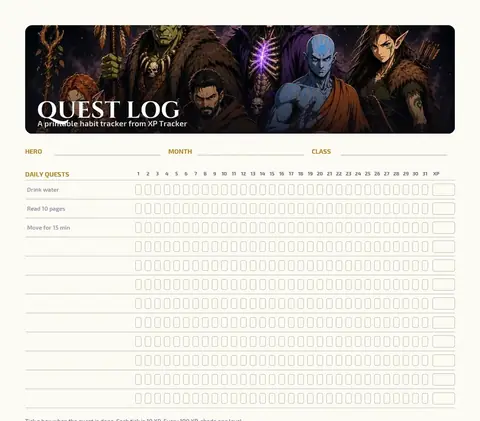
Notice the targets aren't 30 out of 30. Leaving room for misses makes the plan more likely to last the year. A paper tracker works fine for this: try the printable habit tracker.
Plan for the days that break routines
Consistency rarely fails on normal days. It fails on the odd ones. List the disruptions you know are coming and decide your plan for each now:
- Travel: minimum versions only, done wherever you are.
- Illness: rest. Pick the habits up again when you're well, starting at the minimum.
- Late nights and social plans: move the habit earlier in the day, or do the minimum.
- Busy weeks at work: keep one habit, pause the others on purpose, and write the date you'll restart.
A planned pause is very different from drifting away. You decide it, you know when it ends, and coming back takes no effort to explain to yourself.

Common mistakes
- Starting five habits on the same Monday. Pick the two that matter most. Add more when those feel easy.
- Treating the minimum as failure. On a bad day, the minimum is the win. It keeps tomorrow easy.
- Relying on motivation. It shows up on some days and not others. A cue and a minimum don't depend on how you feel.
- Restarting with a bigger plan. After a slip, people often come back with a harder plan to make up for it. Come back smaller.
What the research says
In a study of 96 people building a new daily habit, Phillippa Lally and colleagues (2010) found that missing one day did not materially affect how the habit formed. The time to reach automaticity ranged from 18 to 254 days, with a median of 66, so most habits need months of showing up. Wendy Wood, Jeffrey Quinn and Deborah Kashy (2002) found that about 43% of everyday actions were done almost daily in the same context, which is why a fixed cue and place help so much.
What to do today
Write down your two or three habits for this month. For each, write a cue, a normal version and a minimum. Put a tracker where you'll see it, and do the minimum of one habit today so the count starts at one.
In XP Tracker, each habit is a quest with its own streak. A skipped quest only costs the XP you didn't earn, and rest days keep your streaks, so a sick day doesn't wipe out a month. See how it works.



Questions people ask
Why can't I stay consistent with anything?
Common reasons: too many goals at once, daily targets that need a good day, no fixed time or cue, and quitting after one miss. Fix one of those at a time. Our guide on why you lack discipline goes through the causes.
How do I stay consistent with ADHD?
Lean on outside structure: alarms, visual checklists, habits tied to things you already do, and very small minimums. Many people find quick, visible progress helps. If ADHD makes daily life hard, talk to a doctor or a specialist. Tips like these support routines; they don't treat ADHD.
How do I be consistent in my daily routine?
Keep the routine short, give each part a fixed trigger (after coffee, after work, after brushing teeth) and write a two-minute version for bad days. Review it once a week and change one thing if it isn't working.
Does consistency mean doing something every single day?
No. Consistency means showing up on most of the days you planned. Three workouts a week, kept for a year, is very consistent. Planned rest days are part of it.
What should I do after I break a streak?
Do the habit the next day, even at the minimum. One miss costs very little; a week of not restarting costs much more. See what to do after breaking a streak.
Related pages



Start your journey
Pick a class, do the day's quests, and watch your hero level up with you.
Start free on iPhone and Android.
Scan to install Point your phone camera at the code. iPhone opens the App Store, Android opens Google Play.