 XP TRACKER
How to make a real life RPG character sheet
A real life character sheet is one page that describes you like a game hero: a class, a few stats, the skills you're training, your gear, your current quests and an honest flaw or two. Fill it in once, then update it every month as you level.

Short answer: a real life RPG character sheet is one page with your class, five or six stats scored 1 to 10 from real evidence, the skills you're training, your inventory, your active quests and an honest flaw. You fill it in once and update it monthly. Use the template below.
People make character sheets for fun, and that's reason enough. They're also a useful self-review in disguise. Writing "Stamina 3" with a reason next to it is easier than writing "I need to get fitter", and it points you toward one quest that would raise the number. The game frame makes it lighter to look at where you are.
The idea comes from tabletop games, where a sheet of paper holds everything about a character: what they're good at, what they carry, what they're trying to do. Those sheets are built for dice and combat. A real life version keeps the shape and swaps the content for things you can change with daily habits, like sleep, training, reading and time with people.
Keep the sheet honest and kind. The aim is a starting point you can improve from, not a list of everything wrong with you.
What goes on the sheet
- Name, class and levelYour name or a hero name, and a class that describes the life you're building: Warrior (body and courage), Bard (creating and sharing), Druid (home and health), Monk (calm and focus), and so on. Start at level 1. You'll add a level each time you finish a quest chain or hit a milestone you set.
- Five or six statsPick the areas that matter to you. A common set: Strength, Stamina, Focus, Knowledge, Charisma, Calm. Score each 1 to 10 and write one line of evidence from the last 30 days. Our real life RPG stats guide has stat ideas and ways to raise each one.
- Skills with levelsConcrete abilities, each with a level from 1 to 5: Cooking 2, Spanish 1, Public speaking 1, Driving 4. Skills are narrower than stats and easier to train.
- InventoryThe things that help you play: a bike, a library card, a quiet desk, savings for three months, a friend who'll train with you. Listing them reminds you what you already have.
- Active questsOne main quest for the season and two or three side quests. "Run 5 km without stopping by March" is a main quest. "Try a pottery class" is a side quest.
- Traits and flawsOne or two strengths and one or two flaws, written plainly. "Flaw: I stay up too late on my phone." A flaw on the sheet is something to design around, like a weakness to fire in a game.
Example: a filled-in sheet
Here's a realistic sheet for someone in their late twenties who works in an office and wants more energy and a creative outlet.
| Field | Entry |
|---|---|
| Name and class | Mara, Bard, level 3 |
| Strength | 3: two gym visits in the last month |
| Stamina | 4: walk 6,000 steps on most days |
| Focus | 5: can work 30 minutes without checking my phone, on good days |
| Knowledge | 6: read two books this month |
| Charisma | 5: see friends weekly, nervous speaking in meetings |
| Calm | 3: sleep around six hours, often anxious on Sundays |
| Skills | Guitar 2, Cooking 2, Excel 4, Spanish 1 |
| Inventory | Guitar, library card, gym 10 minutes away, a sister who runs |
| Main quest | Play three full songs at a friend's birthday in May |
| Side quests | Run a 5 km with my sister; cook one new recipe a week |
| Trait / flaw | Trait: curious. Flaw: phone in bed until 1 a.m. |
Look at how the sheet points to the next move. Calm is low and the flaw explains part of it. A side quest like "phone charges in the kitchen" would likely raise two stats at once. You don't need to fix every stat. Pick one or two to raise this month.
Turn the sheet into a game you play
A sheet you fill in once and forget is a nice afternoon. To make it useful, connect it to daily quests:
- One quest per low stat. For each stat you want to raise, write one small daily or weekly quest. Stamina 4 might get "walk 20 minutes at lunch".
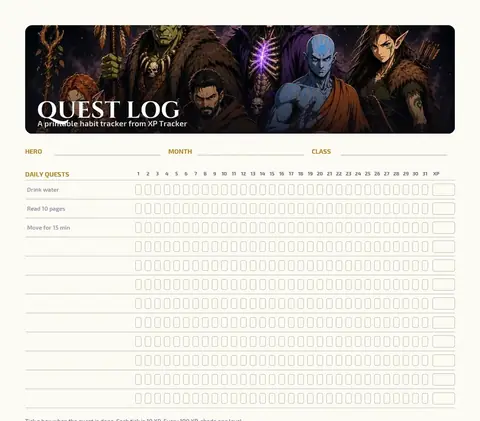
- Track XP somewhere simple. A tally in a notebook or a printable quest log on the fridge.
- Level up on milestones. Add a level when you finish a quest chain, like four weeks of walking, not every time you tick a box.
- Review once a month. Rescore stats with new evidence. Seeing Stamina move from 4 to 5 is the reward the sheet gives you.

Copy this template
- Name, class, level______, ______, level 1
- Stats (1 to 10, with evidence)Strength __ / Stamina __ / Focus __ / Knowledge __ / Charisma __ / Calm __
- Skills (1 to 5)Four or five skills you use or want to learn
- InventoryTools, places, money buffer, people
- Main quest and side questsOne for the season, two or three for fun
- Traits and flawsTwo of each, written plainly
Common mistakes
- Scoring from mood. On a bad day, every stat looks like a 2. Use evidence from the last month instead.
- Twelve stats. More stats feel thorough and get abandoned. Five or six are enough to read at a glance.
- Comparing your sheet to someone else's. Your stats are a record of your own starting line. Another person's 8 tells you nothing about your next step.
- Writing flaws as insults. "Lazy" gives you nothing to work with. "I skip the gym when I go home first" gives you a plan: take the bag to work.
What to do today
Take 20 minutes. Fill in the template on paper, score your stats with real evidence, and pick one stat to raise this month. Write one daily quest for it and put the sheet somewhere you'll see it, like inside a notebook cover or on the fridge. Set a reminder for the first of next month to rescore.
In XP Tracker you choose your first class from its art alone, then play one class at a time. Finishing a class unlocks the next, until you've been through all eight. Each class has its own class quests, levels 0 to 60 and one comic panel per level, so your sheet's level becomes a story you can read. Meet the eight classes.
Questions people ask
What should be on a real life character sheet?
A name and class, five or six stats scored 1 to 10, a list of skills you're training with a level each, your inventory (tools, money buffer, people), active quests, and one or two flaws. Keep it to one page so you'll update it.
What class am I in real life?
Pick the role that describes what you want to be doing more of: a Warrior trains the body, a Bard creates, a Druid tends home and health, an Outlaw questions the rules. It's a frame, not a test. You can try our class quiz for a starting point.
How do I rate my stats honestly?
Tie each score to evidence from the last 30 days. "Strength 4: I trained six times this month" is useful. "Strength 4: I feel weak" isn't. Scores are a starting line, not a grade.
How often should I update my character sheet?
Once a month is a good rhythm. Update stats and skill levels, close finished quests, add new ones. Daily updates make it a chore; yearly updates make it a memory.
Can I use a D&D character sheet for real life?
You can, but most tabletop sheets are built for combat rolls. A simpler sheet with life stats like Strength, Stamina, Focus, Knowledge, Charisma and Calm fits real goals better.
Related pages



Start your journey
Pick a class, do the day's quests, and watch your hero level up with you.
Start free on iPhone and Android.
Scan to install Point your phone camera at the code. iPhone opens the App Store, Android opens Google Play.