 XP TRACKER
How to track habits on paper
Draw a grid with your habits down the side and the days of the month across the top, put it where you'll see it every evening, and fill in a box each time you do the habit. That's the whole method. Below are five layouts and how to pick one.

Short answer: list two to five habits down the left of a page, draw one column per day of the month, and shade a box each day you do the habit. Keep the page where you'll see it every evening, like the fridge or your bedside table. Count each row at the end of the month and start a fresh page.
Paper is the quickest way to start tracking. You need a pen and five minutes, and nothing nags you with notifications. A sheet on the wall also does something a phone can't: it sits there in plain sight, so the gaps and the good runs are visible every time you walk past.
The idea is old. In his autobiography, Benjamin Franklin described a small book with a page for each week, his 13 chosen virtues in rows and the days of the week in columns. He marked a spot for each slip and focused on one virtue per week, cycling through all 13. You can do the same with a biro and a page from a notebook.
Five layouts to copy
- The monthly gridHabits in rows, days 1 to 31 in columns, a total column at the end. It's the most common layout because you see a whole month at once. Best for two to six daily habits.
- The X calendarA wall calendar with one habit. Draw a big X on each day you do it. The row of crosses becomes a chain you don't want to break. Best for one habit you care most about.
- The weekly pageOne page per week in a planner, habits in rows, Monday to Sunday in columns, with space under each day for a note. Franklin's version. Best if you plan weekly and want room to write why a day went the way it did.
- The year in dotsTwelve rows of 31 small circles, one row per month, for a single habit. Fill a dot each day. Best for a long habit like reading or walking, where you want to see a whole year on one page.
- The index cardOne card per week with your habits and seven tick boxes, kept in your pocket or wallet. Best if you're out of the house all day and log on the go.
How to draw a monthly grid in five minutes
- Title and monthWrite the month at the top. Under it, one line on why you're doing this, in your own words.
- Habits with definitionsDown the left, write each habit with its minimum: "Read (10 pages)", "Walk (20 min)", "Bed by 11".
- Day columnsDraw 28 to 31 narrow columns. Number them along the top. Mark the weekends lightly so you can spot weekend patterns later.
- Totals and notesAdd a "total" column on the right and a few blank lines at the bottom for notes on hard days.
- Pick your marksA filled box for done, a dot for a planned rest day, and a blank for a miss. Keep the misses blank, never crossed out.
Here's what the end of a month might look like for three habits:
| Habit (done means) | Days done | Rest days | What the page showed |
|---|---|---|---|
| Read (10 pages) | 24 of 30 | 0 | Missed days were all late nights out |
| Walk (20 min) | 17 of 30 | 4 | Strong on weekdays, weak on rainy weekends |
| Bed by 11 | 19 of 30 | 0 | Sundays slipped every week |
Those three notes give you next month's fixes: plan a rainy-day walk route and set a Sunday-only alarm for bedtime. For a fuller look back, the monthly habit review walks through it step by step.
Keep it going after week two
Most paper trackers die in the second or third week. The page gets buried, the evening routine changes, or a few blanks make it look "ruined". These habits keep it alive:
- Hang it up. A tracker on the wall gets filled in. A tracker in a drawer doesn't.
- Leave a pen with it. Tape one to the fridge or tie it to the notebook.
- Log at one fixed moment. After brushing your teeth at night is a good one, because you never skip it.
- Accept a messy page. A month with gaps is still a useful record. Don't start over because the page looks imperfect.
- Start fresh on the first. A new month is a clean page with no history to live up to.

Common mistakes
- Too many rows. Twelve habits fill the page and take ages to log. Five is a sensible limit.
- Decorating instead of tracking. A beautiful layout is fine if you enjoy drawing, but it shouldn't take longer than the habits. Plain lines work.
- Hiding the tracker. If you have to remember to find it, you'll forget to fill it in.
- Crossing out misses in red. It makes the page feel like a report card. Leave misses blank.
- No review. Five minutes at the end of the month turns the page from a record into a plan.
What to do today
- Pick a layoutThe monthly grid if you're unsure, or the X calendar for one habit.
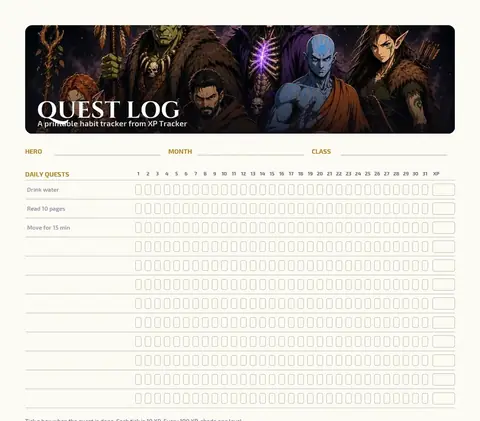
- Draw or print itFive minutes with a ruler, or use the printable tracker.
- Hang it up with a penThen fill in tonight's boxes before bed.
If you later want reminders and a running history, XP Tracker works like a paper tracker that fights back: each habit is a quest with its own streak, finishing it earns XP, the XP also damages a boss, and levels drop loot and pet eggs. You can keep a paper page on the fridge too. See how it works.
Questions people ask
How do I make a habit tracker in a notebook?
Write your habits down the left side of a page, then draw columns for the days of the month (28 to 31) across the top. A ruler helps but isn't needed. Leave a column at the end for the month's total.
Is a paper habit tracker better than an app?
Neither is better for everyone. Paper is free, quick and always visible if it's on a wall. An app adds reminders and keeps history. Many people start on paper to learn which habits they care about, then decide.
What should I put in a paper habit tracker?
Two to five habits you're building right now, each with a short definition of done, like "10 pages" or "20-minute walk". See habit tracker ideas for a long list.
Where should I keep my paper tracker?
Somewhere you pass every evening: the fridge, the bathroom mirror, the inside of your front door, or open on your bedside table. A tracker inside a closed notebook is easy to forget.
Can I print a habit tracker instead of drawing one?
Yes. The printable habit tracker and the habit tracker generator give you a ready sheet with your own habits on it.
Related pages



Start your journey
Pick a class, do the day's quests, and watch your hero level up with you.
Start free on iPhone and Android.
Scan to install Point your phone camera at the code. iPhone opens the App Store, Android opens Google Play.